Reflections, Field Notes, and Gifts
Weekly reflections, field notes, images, and meditations drawn from the published, forthcoming, and developing works of Mark Horacek.
Welcome to Reflections, Field Notes, and Gifts
This page gathers short public pieces from across the larger body of my creative work — books already published, books nearing publication, and works still coming into being.
Some entries begin with a poem, an image, a scene, a map, a creature, a wound, a question, or a line of thought. Some come from Survivors of the Silent Earth. Some come from The Eternal Gifts, Human Concerns in an Age of AI, A Thought for Every Day of the Year, the wider Thought for Life Series, and other works in progress.
Each post is meant to stand on its own. But each one also opens a small doorway into a larger field of meaning: truth, love, discernment, family, survival, care, consequence, nature, spirituality, technology, and the difficult work of remaining human.
The website is the home for these fuller reflections. Social media may point toward them, but the richer thought lives here.
New posts are planned for Wednesdays and Saturdays.
What You’ll Find Here
Reflections — meditations on truth, love, meaning, spirit, care, grief, hope, and remaining human.
Field Notes — story-based insights, worldbuilding notes, creature studies, science reflections, maps, survival questions, and behind-the-scenes discoveries.
Gifts — tender reflections drawn from love, family, memory, home, gratitude, and the sacredness of ordinary life.
Behind the Work — brief notes on how an image, chapter, framework, scene, or idea came into being.
Remaining Human — reflections on discernment, technology, AI, moral choice, human partnership, and the future we are building.
This Week’s Themes
Week of June 17–23, 2026
Wednesday’s Theme: The Need to Matter
Meaning, value, and the shared landscape of human concern
Saturday’s Theme: The Work of Discernment
Core life concerns and the foundations of reliable judgment
This week’s reflections turn toward the human concerns that lie beneath every age of change.
On Wednesday, The Need to Matter explores meaning, value, and the longing to know that our lives count. It considers how these questions belong to the shared landscape of human concern: the place where our choices, fears, hopes, responsibilities, and love begin.
On Saturday, The Work of Discernment turns toward the core domains of life concern and the foundations of reliable judgment. It asks how we can think more clearly when complexity presses in, how we can name the kind of problem before us, and how wisdom often begins by refusing to solve the wrong problem.
Together, these paired features explore one of the central human tasks of a confusing age: learning to think clearly about what matters before rushing toward answers. They turn toward meaning, value, concern, and discernment — the work of recognizing what kind of problem we are facing, what is truly at stake, and how wisdom begins with the ability to pause, name the concern, and see more truthfully.
The Need to Matter
Wednesday June 17, 2026
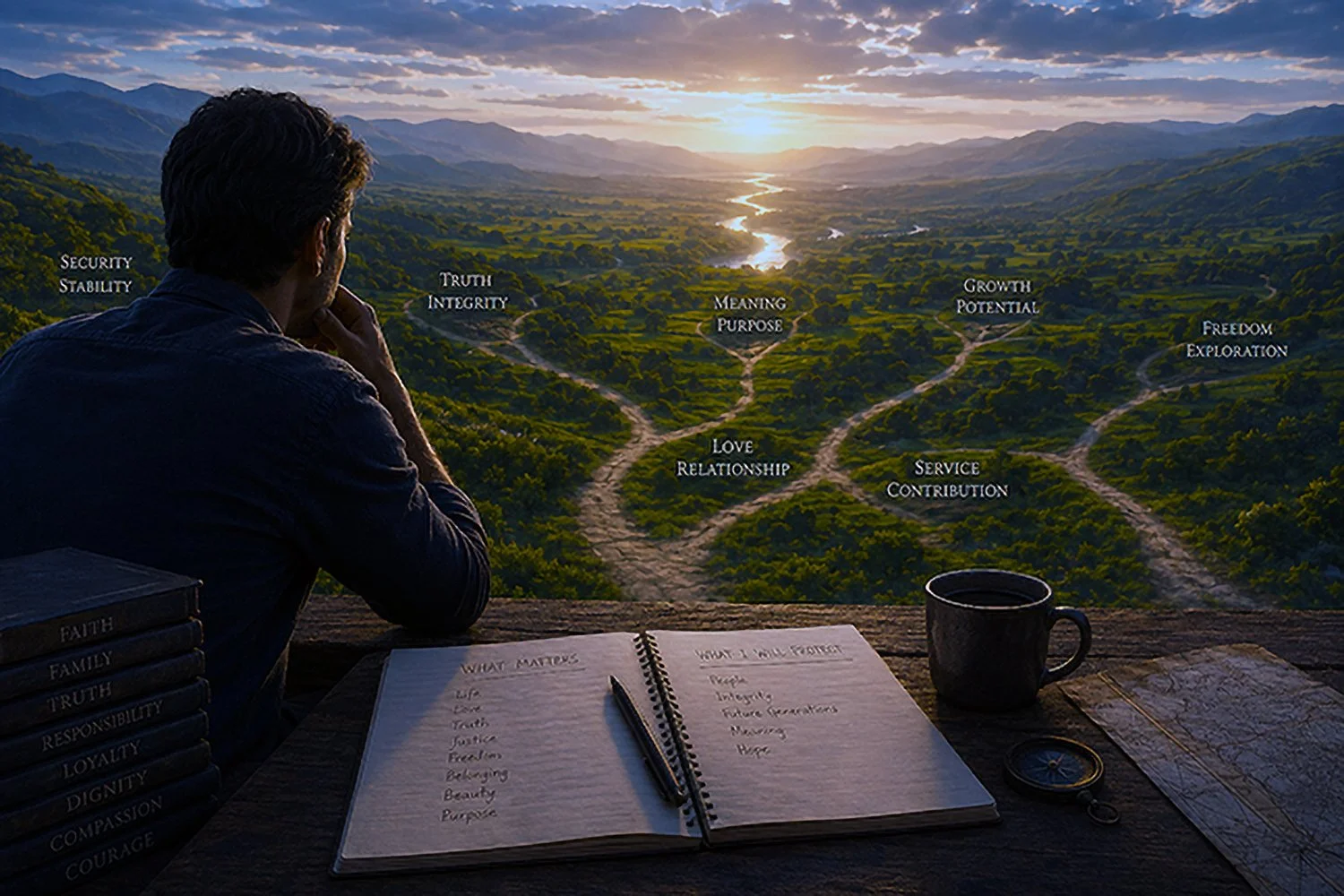
The Landscape of Meaning
When what matters becomes the map of a life.
Drawn from Human Concerns in an Age of AI, a forthcoming work on discernment, problem-solving, and human decision-making in a world of complexity and rapid change.
In the image, a person looks out over a wide valley of branching paths. Across the landscape appear words such as security, truth, meaning, love, service, growth, and freedom. In the foreground, an open notebook asks two quiet questions: What matters? What will I protect?
The image represents a central human truth: life is not navigated by information alone. Beneath our choices, commitments, fears, hopes, and relationships are values that shape what we notice, what we pursue, what we refuse, and what kind of future seems worth building.
Reflection
Human beings do not live by facts alone.
Facts matter. Circumstances matter. Pressures matter. But facts do not tell us, by themselves, what deserves our loyalty, what calls for sacrifice, what must be protected, or what kind of future would still feel worthy of human life.
For that, we need values.
Values are not decorative additions to life. They are not pleasant ideas placed around the edges after the serious work is done. They are part of the serious work. They shape what a person treats as important, what they admire, what they grieve when it is lost, and what they cannot bring themselves to betray.
Most of the time, values are present before they are fully named.
We learn them through family, culture, love, loyalty, suffering, faith, responsibility, disappointment, work, memory, and repeated experience. We absorb them through what was praised, what was protected, what was neglected, what was excused, and what was asked of us. Over time, they become part of the inner landscape through which we interpret the world.
That is why two people can face the same situation and experience it differently.
One person may see a responsibility as a burden. Another may see it as a calling. One may see sacrifice as loss. Another may see it as love. One may see a difficult truth as a threat. Another may see it as the beginning of freedom.
The event may be similar.
The meaning is not.
Meaning is shaped by what we care about. It is not simply waiting inside events like a fixed object. Human beings interpret life through the values they carry, the relationships they cherish, the responsibilities they accept, and the hopes they believe are still worth serving.
That is why the need to matter is not vanity.
To matter is not merely to be noticed. It is to know that one’s life has weight in the world. It is to sense that our choices, presence, work, love, and care participate in something larger than survival or performance. It is to know that we are not only functioning, producing, or enduring, but helping shape a life that carries meaning.
In confusing times, this becomes especially important.
When change accelerates, people may begin measuring themselves by whatever the age most loudly rewards: speed, usefulness, output, attention, efficiency, competition, or visible success. But none of those measures is large enough to hold the full dignity of a human life.
A person may be productive and still feel empty.
A person may be useful and still feel unseen.
A person may be efficient and still lose touch with what is worth preserving.
So the deeper question is not only, What can I do?
It is also, What matters enough to guide what I do?
That question does not remove complexity. Sometimes values come into conflict. Security may compete with freedom. Stability may compete with growth. Loyalty may compete with truth. Care for others may compete with self-protection. Ambition may compete with presence.
When those conflicts remain unnamed, they often appear only as confusion, anxiety, or inner strain. But when values are brought into clearer view, a person can begin to understand what is actually being weighed and why one path may feel wrong even when it appears practical on the surface.
To clarify values is not to become abstract.
It is to become more honest.
It is to ask what is already governing life, whether it deserves that authority, and whether our choices are serving what truly matters or merely what feels urgent in the moment.
The image shows many possible paths across a valley. But the deeper question is not which path is easiest, fastest, or most impressive. The deeper question is which path remains faithful to what is worthy of trust.
Values do not make life simple.
They help us see more truthfully.
They remind us that clarity is not only about gathering more information. It is also about knowing what deserves weight, what must be protected, and what kind of person we are becoming as we choose.
When what matters becomes visible, the landscape of life does not become easy.
But it becomes more honest.
And honesty is often where meaning begins.
The Need to Matter
Wednesday June 17, 2026
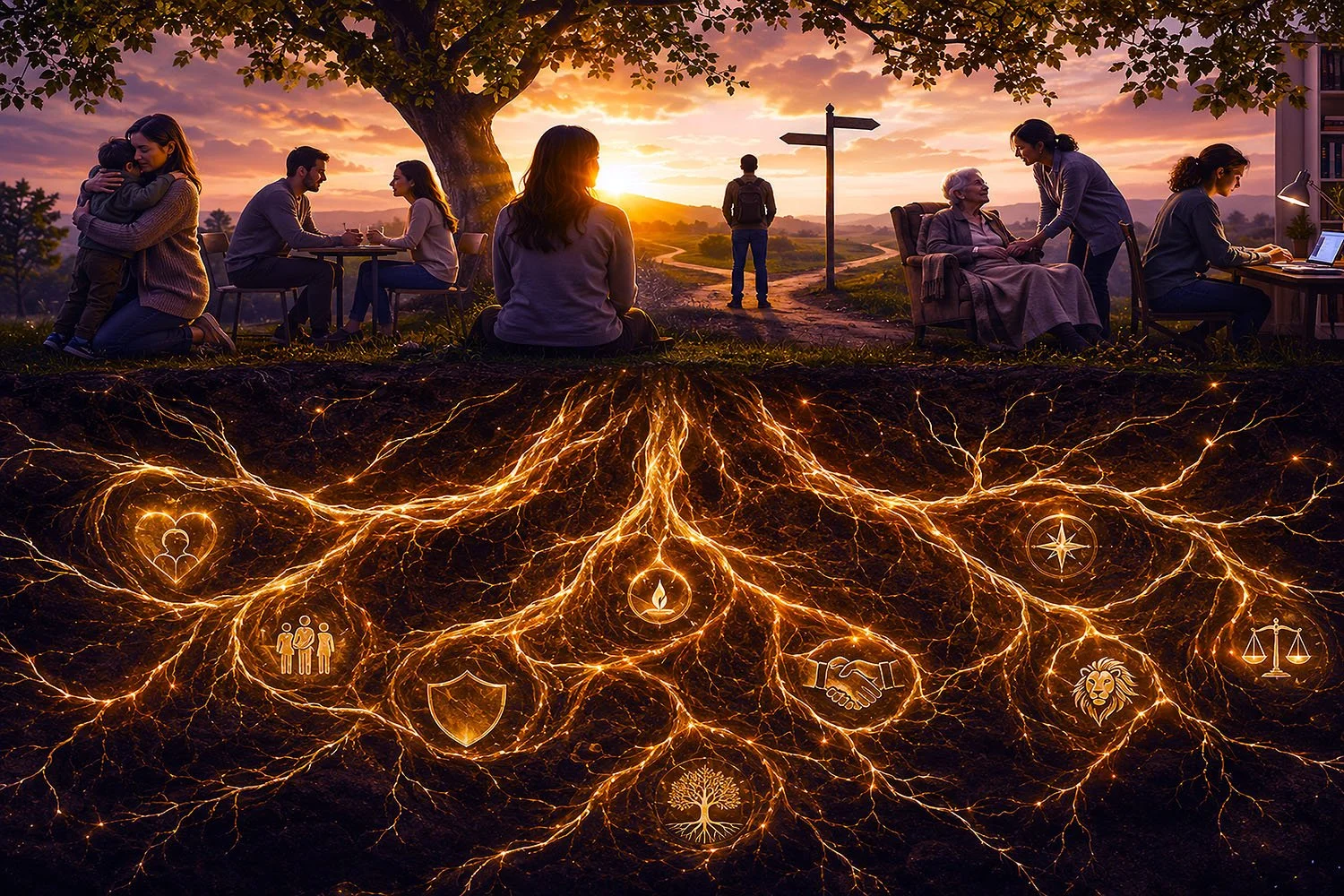
The Hidden Structure of Choice
When values beneath the surface shape what a life protects.
Drawn from Human Concerns in an Age of AI, a forthcoming work on discernment, problem-solving, and human decision-making in a world of complexity and rapid change.
In the image, visible scenes of human life unfold above the ground: a parent holding a child, a couple in conversation, a solitary figure facing a crossroads, a caregiver attending to an elder, and a person working late beside a screen. Beneath these ordinary moments, luminous roots spread through the soil, carrying symbols of family, dignity, truth, courage, justice, responsibility, belonging, and care.
The image represents the central insight: beneath visible choices, roles, fears, hopes, and relationships are values that shape what people protect, pursue, sacrifice for, and refuse to lose.
Reflection
We often notice choices only after they become visible.
A person tells the truth or avoids it. They stay or leave. They protect a relationship or neglect it. They accept a responsibility, refuse a temptation, change direction, remain loyal, draw a boundary, make a sacrifice, or choose one future over another.
From the outside, we may see only the action.
But beneath the action is usually a deeper structure.
Values are part of that hidden structure. They shape what feels important, what feels threatening, what appears worthy, what seems intolerable, and what kind of life a person believes is worth building. They do not make every decision easy, and they do not replace reasoning. But they influence what reasoning gives weight to, what a person notices, and why one possibility may feel right while another feels like betrayal.
This is why values matter so deeply.
Most of us do not move through life carrying a formal list of principles in front of us. We carry something quieter and more powerful. We carry what we have learned to love, fear, admire, protect, and grieve. We carry the memory of what formed us, the loyalties that shaped us, the wounds that warned us, the responsibilities that claimed us, and the hopes that still call us forward.
Over time, these become roots.
They spread beneath the visible surface of life. They feed our judgments before we can fully explain them. They shape the meaning of events before we have finished thinking them through. They influence what we call success, what we call failure, what we call courage, what we call compromise, and what we believe must not be lost.
That is why two people may face the same facts and still make different choices.
The difference is not always intelligence. It is not always information. Often, the difference lies in what each person believes deserves weight. One person may choose security because they know what chaos costs. Another may choose freedom because they know what confinement destroys. One may choose loyalty because belonging is sacred to them. Another may choose truth because silence has already done too much harm.
Hard choices are often hard because values are in tension.
Security may compete with freedom. Loyalty may compete with truth. Care for others may compete with self-protection. Efficiency may compete with dignity. Ambition may compete with presence. Stability may compete with growth.
When these tensions remain unnamed, they often feel only like confusion, anxiety, guilt, anger, or inner strain. But when values are brought into clearer view, a person can begin to understand what is really being weighed. The problem becomes more honest. The choice becomes more visible. The question changes from “Why does this feel so difficult?” to “What important things are in conflict here?”
That question matters.
In a world of complexity and rapid change, people are often pressured to move quickly from problem to solution. Decide faster. Produce more. Adapt immediately. Keep up. Do not fall behind. But speed is not the same as wisdom, and a fast answer to the wrong problem may only deepen the harm.
Reliable discernment begins by slowing down enough to see what is beneath the surface.
What is being protected?
What is being threatened?
What value is being served?
What value is being sacrificed?
What kind of person, relationship, institution, or future will this choice help create?
These questions do not remove difficulty. They deepen honesty. They remind us that human decision-making is never only technical. It is moral, relational, emotional, practical, and spiritual. It involves not only what can be done, but what should be done. Not only what works, but what is worthy. Not only what solves the immediate pressure, but what preserves the deeper conditions of a meaningful life.
The image shows this through roots.
Above the ground, life appears in separate scenes. A family. A relationship. A crossroads. A caregiving moment. A person working. These may look like different parts of life, but beneath them the roots are connected. What guides one part of life often reaches into another. The values that shape how we love may also shape how we work. The values that shape how we care for the vulnerable may also shape how we use power. The values that shape what we refuse to lose may also shape what we are willing to sacrifice.
A life is not made only of visible decisions.
It is made of the roots that feed them.
This is why values must be examined, not merely assumed. Some values are worthy of trust. Some have been inherited without being tested. Some have been distorted by fear, pride, pain, pressure, or imitation. Some need to be strengthened. Some need to be reordered. Some need to be released because they have been governing life without deserving that authority.
To clarify values is not to become abstract.
It is to become more truthful about what is already shaping us.
It is to ask whether our choices are being guided by what truly matters or merely by what feels urgent, rewarded, familiar, or safe. It is to ask whether the roots beneath our decisions are deep enough to hold us when pressure comes.
Because pressure will come.
And when it does, values become visible.
They appear in what we protect when protection costs us something. They appear in what we refuse when refusal is inconvenient. They appear in what we tell the truth about, what we make time for, what we repair, what we defend, and what we continue to love when easier options are available.
The hidden structure of choice does not remain hidden forever.
Eventually, it becomes a life.
And when the roots are shaped by truth, love, dignity, courage, responsibility, and care, the choices that grow from them become more trustworthy. Not perfect. Not painless. Not simple. But more deeply human.
That is why values matter.
They are not merely what we say we believe.
They are what quietly teaches our choices what to become.
Love That Endures
Saturday June 13, 2026
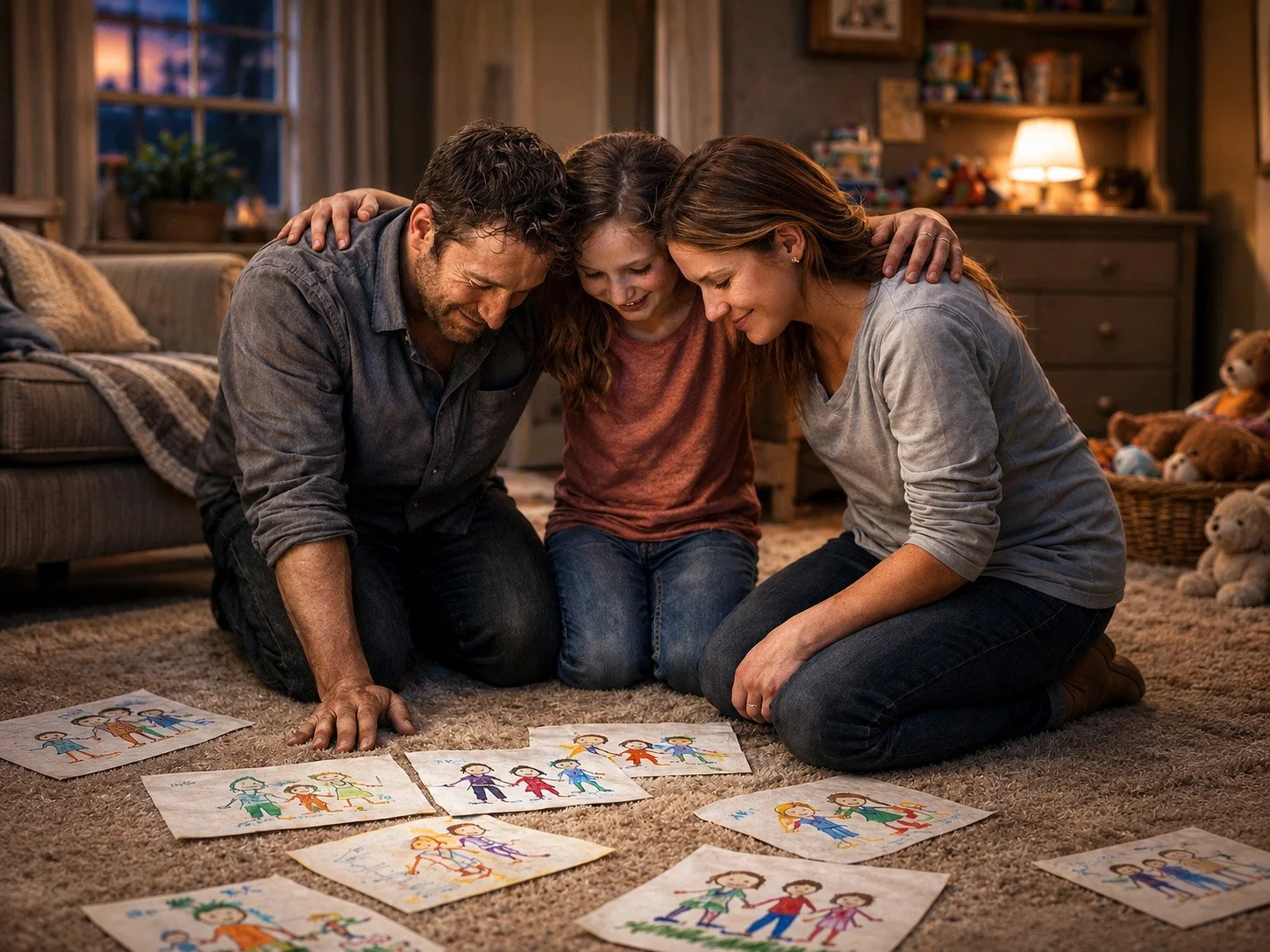
The Heart of Home
When love becomes the world a child trusts.
Inspired by a poem from The Eternal Gifts: Love, Life, and Death — Second Illustrated Edition
In the image, a family gathers close on the floor of a warmly lit room, surrounded by a child’s drawings and the quiet signs of home. The moment is simple, but its meaning is deep: love is becoming visible not through spectacle, but through presence, attention, and the trust that grows when a child is held inside a circle of care.
Reflection
For a child, home is never only a place.
It is a pattern of love. It is the repeated experience of being seen, welcomed, protected, and cherished. It is the quiet lesson, taught long before words can fully explain it, that life can be entered without fear because there are arms that hold, faces that soften, and hearts that remain near.
This is one of love’s first great gifts.
Before a child understands the world in its complexity, the child learns the world through relationship. The tone of a voice, the nearness of a parent, the patience of shared attention, the tenderness of ordinary moments — these become part of the inner structure through which trust is formed. A home shaped by love becomes more than shelter. It becomes a first education in belonging.
That is why such moments matter.
What seems small from the outside may be enormous in the life of the heart. To kneel down into a child’s world, to pause, to look, to listen, to share delight in what the child has made — these are not minor acts. They tell the child, You are worth my time. What matters to you matters to me. You do not live in this world alone.
Love does not have to be loud to be life-giving.
Often it is quiet. Repeated. Faithful. It becomes visible in the people who stay, the care that returns each day, and the presence that turns an ordinary room into a place of safety.
The heart of home is not perfection.
It is presence.
And when love becomes the world a child trusts, something lasting has already begun.
Love That Endures
Saturday June 13, 2026
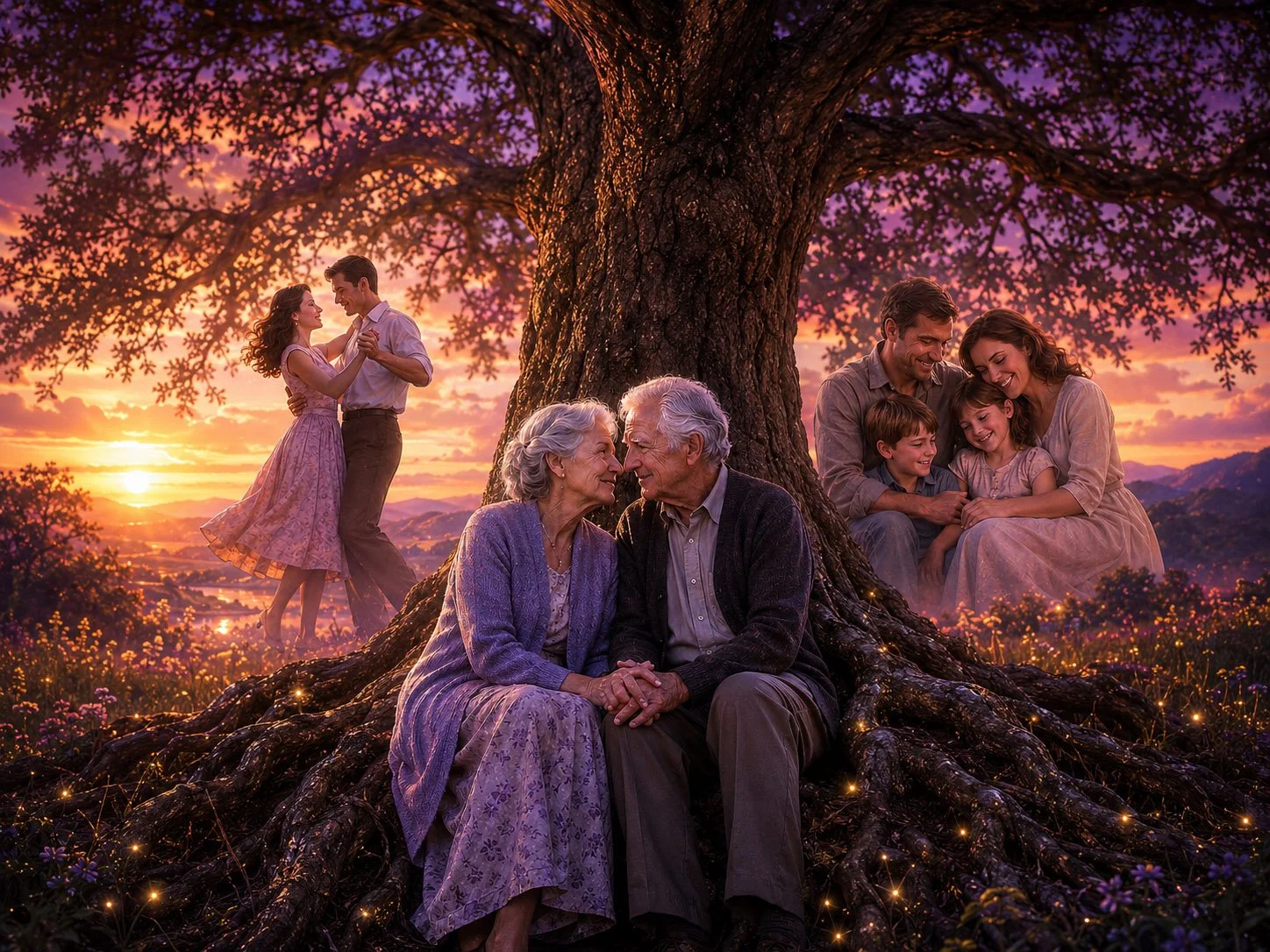
Sharing the Twilight of Life
When love passes through time and remains whole.
Inspired by a poem from The Eternal Gifts: Love, Life, and Death — Second Illustrated Edition
In the image, love appears across the long arc of a life: young love beginning in brightness, family love gathered in tenderness, and aging love seated quietly beneath the shelter of an old tree. The scene reminds us that love is not measured only by its beginning, but by what remains when time has tested it.
Reflection
Some love is first known in brightness.
It begins with wonder, attraction, hope, laughter, and the sense that life has opened into something larger than the self. Young love often carries the radiance of beginning. It looks forward. It imagines. It believes in the future before the future has asked very much of it.
But love is not proven only by how beautifully it begins.
It is revealed by what it becomes over time.
A lasting love passes through seasons. It learns the weight of ordinary days. It carries work, worry, forgiveness, illness, disappointment, change, memory, and the quiet sacrifices that rarely announce themselves. It discovers that devotion is not one grand declaration, but a thousand smaller choices made when no one is applauding.
To share the twilight of life is to know love after it has been changed by time and still remains.
It is the hand still held when youth has softened into memory. It is the face still cherished after age has written itself across the skin. It is the presence that says, “I know the years have changed us, but I am still here.” Such love has moved beyond performance. It no longer needs to prove itself with noise. Its beauty is quieter, deeper, and more rooted.
This kind of love is not untouched by grief.
It knows that time gives and takes. It knows that every season of life asks something different from the heart. It knows that the body changes, children grow, dreams are revised, and the world does not remain as it was when love first began.
Yet love that endures does not depend on everything staying young.
It becomes faithful through change.
It becomes tender through memory.
It becomes whole not because nothing was lost, but because something sacred was kept.
In the image, the old tree becomes a symbol of that endurance. Its roots hold the ground. Its branches shelter the passing generations. Beneath it, love is shown not as a single moment, but as a life lived through many forms: the dance of beginning, the embrace of family, and the quiet companionship of age.
Love that lasts becomes a home inside time.
It gathers what has been lived and gives it meaning. It teaches us that the deepest gifts are not always the brightest ones. Sometimes the greatest gift is the person who remains. The one who remembers. The one who has seen us through years of becoming and still chooses closeness.
The twilight of life is not empty when love remains there.
It is filled with memory, gratitude, tenderness, and the quiet beauty of having shared the road.
And perhaps this is one of love’s eternal gifts: that even as time changes everything around us, love can still become the place where the heart recognizes home.
Discernment Through Clues
Wednesday June 10, 2026
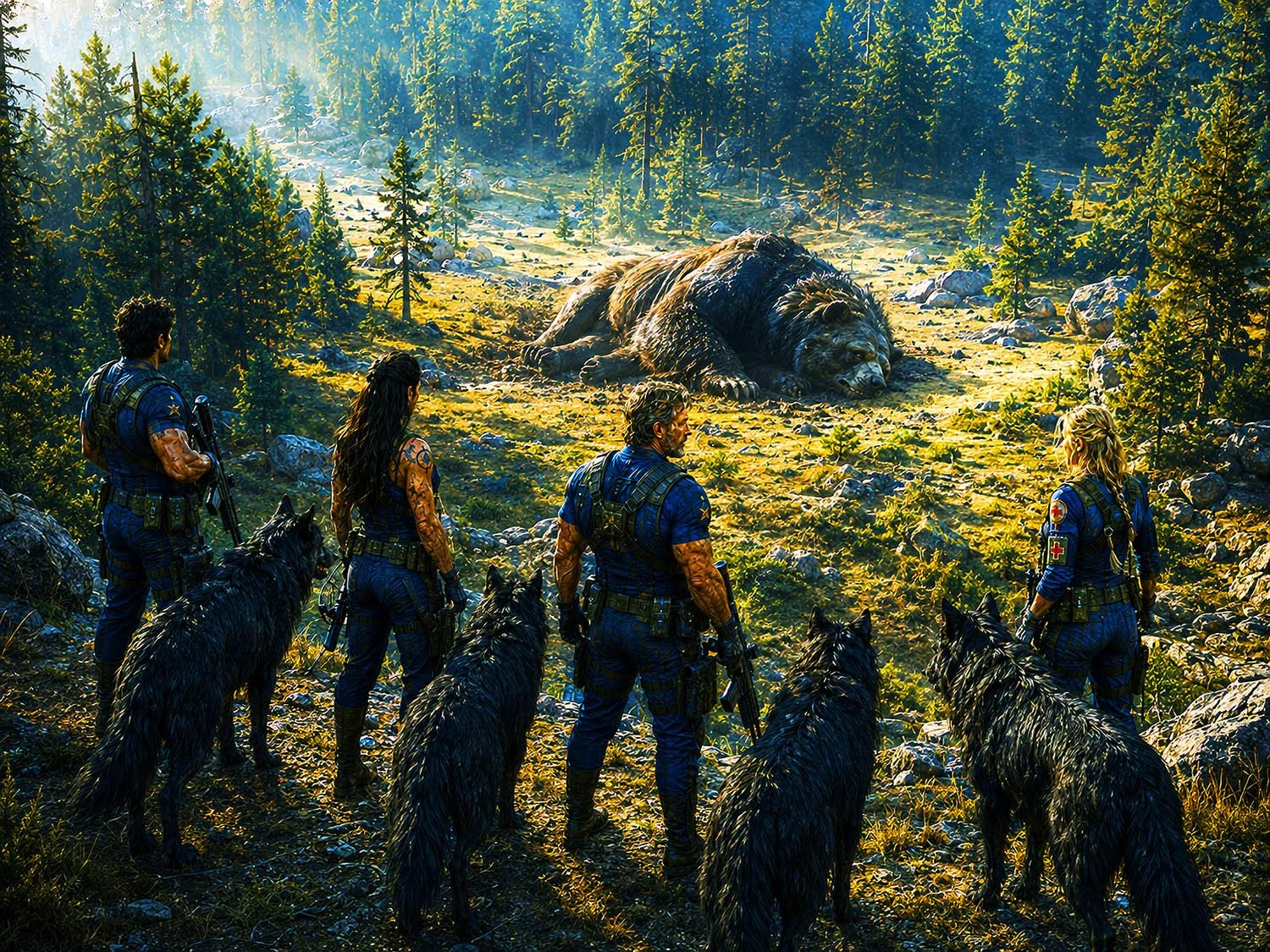
When Complexity Is Overwhelming
Complexity becomes bearable when we stop trying to solve the whole problem at once and begin discerning the shape of its most important pieces.
Inspired by a scene from Survivors of the Silent Earth — Reader’s Edition
In the image, the survivors stand at the edge of a mystery: a massive post-Fall grizzly dead in the basin, not torn apart by ordinary predation, but stopped by something more precise and more powerful. The question is not merely what happened. The question is what the evidence allows them to know.
Reflection
When complexity overwhelms us, the mind often tries to hold everything at once. Every detail appears urgent. Every consequence feels connected to every other consequence. The whole problem becomes so large that we may mistake our inability to solve it immediately for an inability to solve it at all.
But the human mind was not made to grasp every piece of a difficult reality in a single act. It must discern. It must reduce. It must ask what kind of problem it is facing, what pieces are elemental, and which part must be understood first.
A puzzle is rarely solved by seeing the whole picture at once. It is solved by learning the shape of individual pieces. An edge. A color. A line. A small connection that makes the next connection possible. So it is with life. We do not always need to solve the whole difficulty today. We need to find the piece that gives us a way to begin.
The first act of wisdom in complexity is not panic.
It is discernment.
Name the kind of problem. Find one fundamental component. Choose the piece that matters most. Begin there, not because the whole has become simple, but because the mind now has a framework it can manage.
And once one true piece is placed, the next may become visible.
Science Behind the Shadowstalker
Wednesday June 10, 2026