
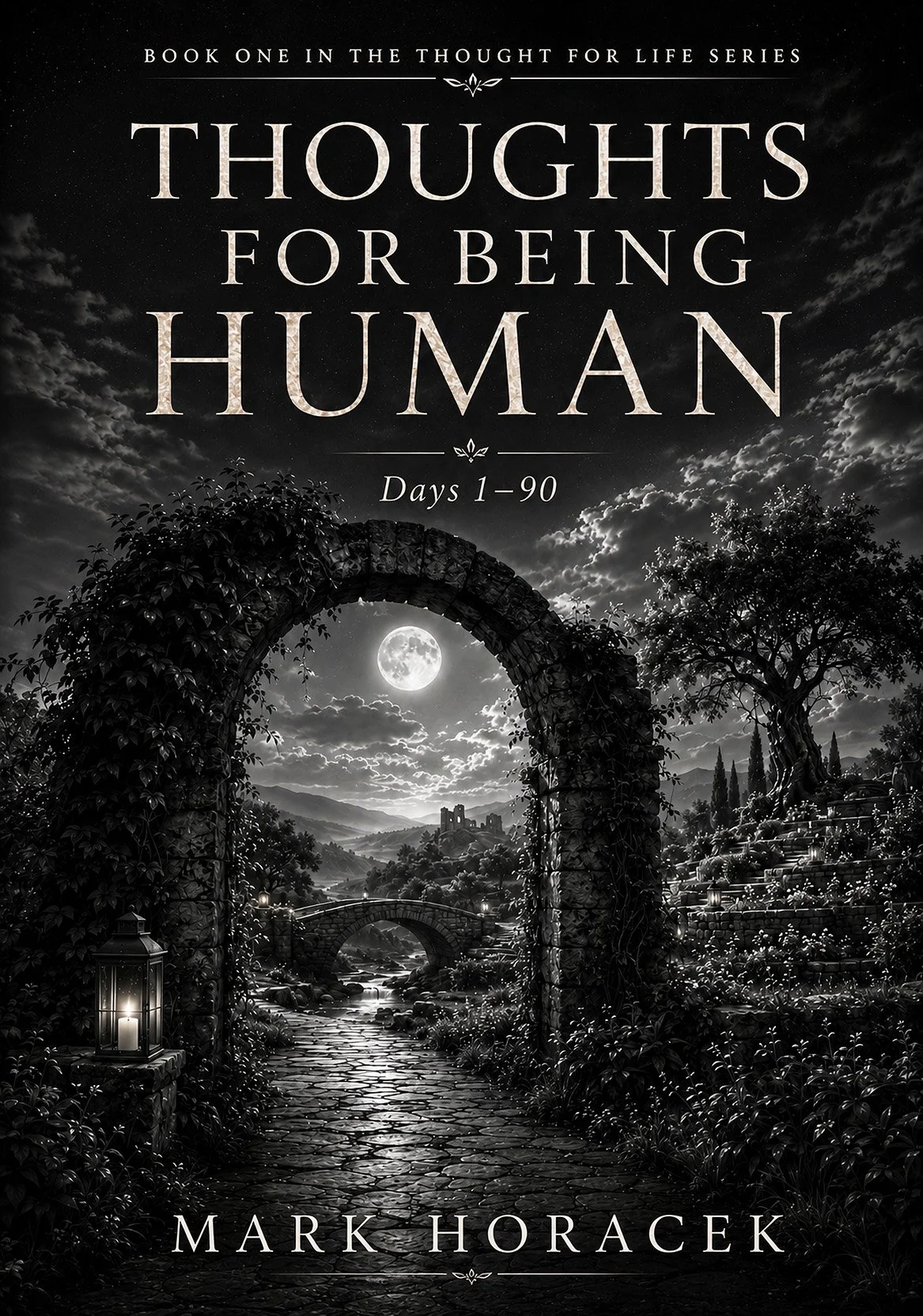
Thoughts for Being Human
Ninety Reflections on Truth, Love, Responsibility, Discernment, and Remaining Human Under Pressure
Thoughts for Being Human is Book One in the Thought for Life Series, a reflective collection written for readers seeking clarity, steadiness, and meaning in difficult days.
These ninety reflections gather themes that move across Mark Horacek’s larger body of work: truth, love, moral responsibility, discernment, survival, service, friendship, mortality, and the effort to remain human under pressure. In this book, those ideas are distilled into a quieter daily form — one thought at a time, one reflection at a time, one invitation to pause, examine, remember, and return.
This is a book for thoughtful readers, difficult seasons, quiet mornings, late nights, and anyone trying to live with greater courage, humility, tenderness, and care.
A Reflective Companion for Difficult Days
A Reflective Companion for Difficult Days
Thoughts for Being Human offers ninety reflections meant to be read slowly, either one day at a time or as companions for particular moments of life. Across six parts, the book moves from truth, discernment, and responsibility toward moral pressure, mercy, growth, service, friendship, mortality, and stewardship.
Each reflection begins with a single thought, then opens into a meditation on what it means to live more truthfully, love more faithfully, choose more wisely, and remain human when life becomes complicated.
The book is not a collection of easy answers. It is an invitation to slow down, look again, and ask what kind of life we are becoming through what we notice, what we love, what we refuse to become, and what we faithfully tend.
Inside Thoughts for Being Human
Thoughts for Being Human is arranged in six parts, each one moving through a different dimension of reflection, growth, and moral formation.
PART I — Beginning, Truth, and Discernment
Learning to see clearly is the beginning of living wisely.
PART II — Trust, Practice, and Purpose
We become more fully formed by the trust we keep, the practices we honor, and the purpose we serve.
PART III — Complexity, Evidence, and Consequence
Wisdom learns to test what it sees before trusting what it believes.
PART IV — Survival, Mercy, and the Living World
From ruin, mercy asks what life may yet become.
PART V — Corruption, Mercy, and Moral Survival
What we become depends on which voice we choose to follow.
PART VI — Growth, Service, and Stewardship
What we faithfully tend may one day shelter more than ourselves.
Together, these ninety reflections form a path from seeing clearly to choosing wisely, from remaining human under pressure to stewarding what has been entrusted to us.
A Glimpse Inside the Book
These excerpts offer two small windows into the journey of Thoughts for Being Human: one from the opening reflection, where the book begins with the possibility of beginning again, and one from the closing reflection, where the first volume gathers into the question of what has been entrusted to us.

Day 1: A New Beginning
A new beginning is not the denial of the past. It is the decision that the past will not be the only voice allowed to shape what comes next.
Every life reaches places where something must begin again. Sometimes the beginning is visible: a new season, a new book, a new home, a new responsibility, a new relationship, a new path. Other times the beginning is hidden. No one else sees it. A thought changes. A truth is finally admitted. A person stops pretending. A quiet decision is made not to keep living by the same fear, wound, habit, or pattern.
New beginnings do not erase what came before. They do not make the past painless. They do not undo every consequence or restore every lost thing. But they can open a different relationship to what has already happened. The past may remain part of the story, but it does not have to remain the author of every next sentence.

Day 90: What Was Entrusted
A meaningful life begins when we stop asking only what belongs to us and begin asking what has been entrusted to us for the good of others, the good of the whole, and the future we will leave behind.
Not everything in our hands belongs to us in the way we first imagine. Some things are ours to possess for a time. But many of the most important things are ours to steward: time, attention, strength, knowledge, influence, love, friendship, skill, opportunity, memory, power, the words we speak, the work we are able to do, and the portion of the world placed within reach of our care.
These things may pass through our hands, but they are not given only for private use. They arrive with responsibility hidden inside them. They ask not merely, “What can you gain from this?” but, “What good can be served through this?”